Press · Territorial Review
For the press.
§ Overview
Territorial Review is a free research platform for the law of Guam, and the first jurisdiction in a project to assemble the law of the five inhabited U.S. territories into one clean, searchable, and free body of law. It is live now at territorialreview.org.
This page collects what reporters and editors need: the launch release, a one-page media fact sheet, and a direct line for interviews and demonstrations. Journalists are welcome to use the platform itself on any Guam story.
§ Downloads
The fact sheet is the recommended leave-behind. Both are formatted for print.
§ Press release · CHamoru
For immediate release · Sunday, June 28, 2026 · Hagåtña, Guam
Territorial Review is now available in CHamoru
HAGÅTÑA, Guam, June 28, 2026. Territorial Review, the free legal-research platform for the law of Guam, can now be read in CHamoru. Every public page of the site carries an English and CHamoru toggle, and the platform's central feature, its plain-language explanation of the law, can now be read in CHamoru beside the English.
The CHamoru option reaches the whole public site, from the navigation and section headings to the description of what each tool does. A reader who prefers CHamoru can move through the platform in CHamoru from the first page forward, at territorialreview.org, free and with no account required.
The clearest example: the doctrine box
The most visible place to see it is the doctrine box, the part of the site that answers a plain question about Guam law. When a person asks something like "Tell me about the Sunshine Act," Territorial Review returns an explanation drawn from the Supreme Court of Guam's own opinions and the Guam Code Annotated, with every supporting citation shown. A "Read in CHamoru" button now opens a second panel, and the explanation fills in line by line in CHamoru while the citations, case names, and section numbers stay exactly as they appear in the law.
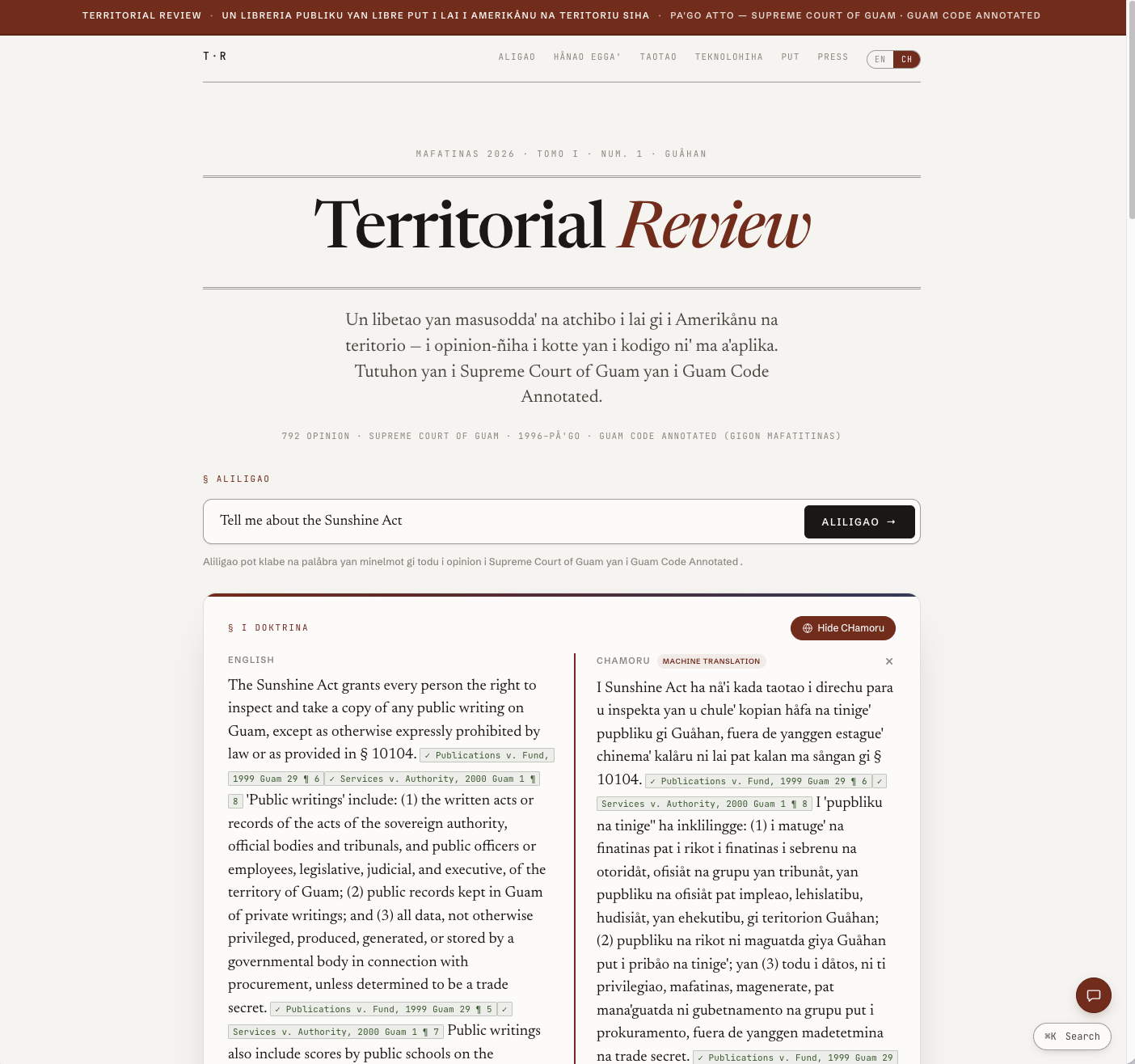
Honest about the machine
The translation is done by machine and is labeled as such. English remains the authoritative source, and a note beneath each CHamoru answer says so plainly. Below the CHamoru panel, a short prompt invites CHamoru speakers to suggest a correction, so that the readings can be improved over time with the help of the language community.
“Putting the law in front of people is only half of access. For many families on Guam, the language of the law and the language of the home are not the same. Offering the law in CHamoru, while being honest about what a machine translation can and cannot do yet, is part of bringing the law closer,” said Karlo Dizon, the founder of Territorial Review.
More to come
The CHamoru reading is one step in a longer effort to make Guam's law usable by the people it governs, not only its lawyers. The same approach is intended to extend, carefully, to the full text of opinions and statutes over time.
Territorial Review remains free to use. Karlo Dizon is available for interviews and live demonstrations. To arrange, contact Tessa Borja, Communications Director, at comms@territorialreview.org.
§ Press release · the People feature
For immediate release · Monday, June 15, 2026 · Hagåtña, Guam
Territorial Review adds a public record of what every Guam senator has actually put into law
HAGÅTÑA, Guam, June 15, 2026. Territorial Review, the free legal-research platform for the law of Guam, today opened a new section that lets anyone track what the senators who make that law have actually done in office. The feature is live now at territorialreview.org/people, free and with no account required.
The section covers the senators of the Guam Legislature going back to the 22nd Legislature, more than ninety members in all. For each one it answers a plain question that has been surprisingly hard to answer until now: what did this senator actually put into the law of Guam?
Built from the public record
Each profile is built from the public record. It shows the Public Laws a senator introduced as prime sponsor, the parts of the Guam Code Annotated those laws touched, and their work in the current term set alongside the full record of earlier ones. A senator who reshaped a single title of the Code shows up differently from one whose work is spread across many, and the page makes that visible at a glance. Where a bill went through a public hearing, the profile links straight to the Guam Legislature's own video of it, so a reader can watch the debate that produced the law.
“We already made the law of Guam free to read. This is the next step, which is making it free to see who wrote it,” said Karlo Dizon, the founder of Territorial Review. “A voter should be able to look up their senator and see the actual record, the laws they sponsored and the sections they changed, not a campaign summary of it. That is what brings a government closer to the people it serves.”
A conservative standard
The attribution is deliberately conservative. A senator is credited only with the bills they introduced as the prime sponsor, not bills they merely cosponsored, and the connections between bills and laws are derived programmatically from the public record. The same standard that governs the rest of the platform applies here. The goal is a record a reader can rely on, not an impression.
Territorial Review treats this as a shared resource. The public and the press are partners in keeping it accurate, and the project welcomes corrections. Anyone who spots an error can write to comms@territorialreview.org.
More to come
The new section is the first of several planned tools for understanding Guam's government, not just its case law and statutes. More are to follow.
Territorial Review remains free to use. Karlo Dizon is available for interviews and live demonstrations. To arrange, contact Tessa Borja, Communications Director, at comms@territorialreview.org.
§ Press release · launch
For immediate release · Monday, June 8, 2026 · Hagåtña, Guam
A free research tool for the law of Guam launches, built to make a public body of law genuinely usable
HAGÅTÑA, Guam, June 8, 2026. A new, free legal-research platform for Guam law went live today at territorialreview.org. It gives practitioners, government officials, self-represented litigants, students, and the public a single place to search, read, and get plain-English answers about the decisions of the Supreme Court of Guam and the Guam Code Annotated, at no cost.
The platform, called Territorial Review, was built by Karlo Dizon, a Stanford Law graduate, Guam-admitted attorney, and former Research Attorney at the Supreme Court of Guam. It is the first jurisdiction in a project to assemble the law of the five inhabited U.S. territories (Guam, the Northern Mariana Islands, the U.S. Virgin Islands, American Samoa, and Puerto Rico) into one clean, searchable, and free body of law.
The launch corpus for Guam is already complete. It carries the 795 Supreme Court of Guam opinions dating to the court's establishment in 1996, and the entire Guam Code Annotated, all 22 titles and close to 18,000 sections of statute. Both are searchable together, side by side.
The problem it addresses
The appellate courts of the U.S. territories decide real cases for nearly four million people, yet their law is among the hardest in the country to find and use. Territorial opinions and codes are public record, but in practice they are scattered, inconsistently formatted, and rarely indexed together. The major commercial research platforms were built for the fifty states and the federal system, and where they reach Guam at all the coverage is partial. A lawyer doing research on Guam works under conditions a mainland lawyer rarely faces. And the people who most need the law, the solo practitioners and legal-aid offices and self-represented litigants, are the least able to pay for it.
“The law of Guam matters enormously to the people it governs, and it is needlessly hard to find,” said Dizon. “I saw that from inside the courtroom. The goal here is simple. Make it free, make it complete, and make it trustworthy enough that a lawyer can actually rely on it.”
What makes it different: an answer engine that cannot invent a case
Territorial Review does more than search. Ask it a legal question and it returns a synthesized, plain-English statement of the doctrine, drawn only from Guam's own opinions and statutes, with every citation shown.
The platform was built directly against the best-known failure of artificial intelligence in law, the fabricated citation, the confidently invented case that has led to court sanctions on the mainland. Because Territorial Review owns and controls its corpus, it can do what most AI tools cannot. Every citation the system produces passes three independent, automatic checks before a reader sees it: that the citation belongs to Guam, that it corresponds to a real opinion actually in the database, and that the cited passage genuinely supports the point being made. A citation that fails any check is flagged on screen, not quietly dropped. The method is AI-assisted. The standard is human-accountable, under a named editor.
That standard reflects the founder's other work. Dizon serves on the New York State Bar Association's Committee on Artificial Intelligence and Emerging Technologies, where the question of how the profession should use these tools responsibly is precisely the subject at hand.
Free where it matters
The platform is free to use, with no account required. It is aimed first at the people for whom an unindexed reporter is effectively a closed door: solo and small-firm attorneys, the public defender and legal-aid community, self-represented litigants, and the students and clerks working on Guam and insular-law questions.
Purpose-built tools for three groups, law firms, government offices, and educators, are scheduled to follow. The public research tool is free and will stay that way.
Available now
Territorial Review is live today at territorialreview.org. It runs hybrid search across cases and statutes, grounded answers governed by the citation firewall, a one-sentence holding for each opinion, clean reading pages with paragraph-level links to the official record, and the ability to ask questions of a single opinion.
Karlo Dizon is available for interviews, demonstrations, and questions. To arrange, contact Tessa Borja, Communications Director, at comms@territorialreview.org.
§ About Territorial Review
Territorial Review is a free archive and research platform for the law of the American territories, beginning with Guam. It pairs a complete, normalized database of territorial appellate opinions and statutory codes with a research layer in which every AI-generated citation is verified against that database before it is shown. The project is editorially independent and human-accountable, led by founder and editor-in-chief Karlo Dizon, a Stanford-trained attorney admitted in New York, Guam, Maryland, and the District of Columbia, a former Research Attorney at the Supreme Court of Guam, and a member of the New York State Bar Association's Committee on Artificial Intelligence and Emerging Technologies.
§ Media contact
For interviews, demonstrations, and questions, contact Tessa Borja, Communications Director, at comms@territorialreview.org. Founder and editor-in-chief Karlo Dizon is available to walk through the platform on camera or by phone.